Interview with Shiv Bhowmik, Author of 50 Ways the Heart Beats
In this author interview, Shiv discusses 50 Ways the Heart Beats, exploring modern love, heartbreak, dating, and the clash between logic and emotion through humour, Hindu mythology, and Dev’s fifty romantic experiences.on Nov 10, 2026
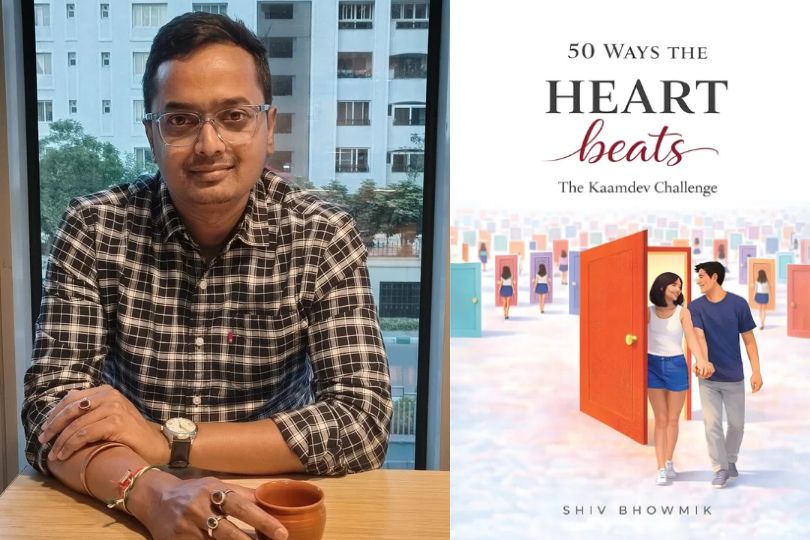
Frontlist: You're a data scientist by day and a novelist by night. How does working with datasets shape the way you plot a story or build a character, if at all?
Shiv: I suppose the data scientist in me cannot help but find patterns, even in human behaviour. I work with data, but as a writer, I’m more interested in the stories behind the patterns. Why do people make the choices they make? Why do we repeat certain mistakes even when we know better? And why does the heart consistently refuse to follow logic?
That said, I have learned that people are not spreadsheets. You cannot simply put someone in a cell, apply a formula, and expect them to behave predictably. If that worked, half the relationship counsellors would be out of business, and Excel would probably have a dedicated romance function by now.
My analytical background does influence how I observe people and structure stories, but emotion cannot always be quantified. And that tension between logic and emotion is something I had a lot of fun exploring while writing 50 Ways The Heart Beats.
Frontlist: Where did the idea of a cosmic bet between Indra and Kaamdev come from, and why did you choose Hindu mythology as the frame for a contemporary rom-com?
Shiv: I wanted to tell a story about the human heart, but I didn't want to write another conventional boy-meets-girl romance. I started wondering what would happen if two gods disagreed about love and decided to settle their argument using a human being.
To be frank, ever since childhood, whenever something went wrong, I would look up and ask, “Why me, God?” I think most of us have had moments like that. At some point, I wondered, what if the gods really were behind some of the things that went wrong in our lives, including our romantic misadventures? What if we were their pawns, their little experiments? That thought eventually became the cosmic bet between Indra and Kaamdev.
Indra wants order and accountability, while Kaamdev is happy to let things get messy. One would probably want heartbreaks documented and filed properly, while the other would be busy creating the next romantic disaster. If you look at the two characters, Indra thinks with his head, while Kaamdev follows his heart. So, the challenge is essentially a game between the mind and the heart. And we all know how complicated things can get when the two refuse to agree!
As for Hindu mythology, I'm a Hindu, and the religion and its culture are familiar to me. It felt natural to draw inspiration from them and bring these divine characters into a contemporary setting. This allowed me to explore love through situations we recognise in everyday life, from awkward dates and family expectations to workplace politics and all the confusion that comes with relationships.
And honestly, if the gods are going to interfere in our love lives, I think they're entitled to a little chaos of their own.
Frontlist: Dev goes through fifty doomed romances. How did you keep each one distinct and fresh, and did you have a favourite disaster to write?
Shiv: The idea was to make sure Dev wasn't simply repeating the same relationship fifty times with different names. Each experience had to bring out a different side of him, whether it was his immaturity, his expectations, his tendency to impress someone, or his gradual understanding of what a relationship actually requires.
His experiences range from innocent, almost childlike crushes to the complications of adult dating, workplace relationships, intellectual rivalries, and family expectations. Every relationship has its own story, its own brand of chaos, and something different to teach him.
As for my favourite disaster, I'd pick the relationship involving the Relationship Dashboard. Imagine being in a relationship where your partner starts tracking quality time, affection, compatibility, and even your Affectionate Gestures to Minor Annoyances Ratio. At that point, you're not dating someone anymore. You're attending a quarterly performance review, and your relationship renewal depends on the numbers!
I particularly enjoyed writing that episode because, as someone who works with data, I could bring a little of my professional world into the story. We spend so much time trying to measure and optimise everything in our lives that sometimes we forget that human relationships don't necessarily work that way. You can analyse a relationship all you want, but the heart doesn't always cooperate with the spreadsheet.
Frontlist: The gods live-commentate Dev's love life. What was it like writing the divine banter, and how did you balance the comedy with the emotional stakes?
Shiv: Writing the banter was probably the easiest part of the book. You see, I have this habit of escaping into a parallel world of Bugs Bunny and other cartoon characters whenever life gets too serious. It's my way of avoiding stress I never signed up for, whether personal or professional. So, putting witty words into the mouths of two gods came quite naturally to me. In fact, it's my comfort zone!
Indra and Kaamdev have very different philosophies. Indra sees the risks, the disorder, and the emotional damage, while Kaamdev sees the possibilities and the sheer absurdity of being human. I enjoyed putting them in the same room because they could look at the exact same situation and arrive at completely different conclusions. One wants to manage the situation, and the other is probably looking forward to seeing what goes wrong next.
But the comedy had to serve the story. I didn't want to make heartbreak itself a joke. Dev's experiences might look hilarious from the outside, but his feelings are genuine. When he experiences loss, confusion, or disappointment, those emotions have to matter to the reader.
The gods might treat his life like an experiment, but Dev is the one who has to live through it. And as the story progresses, he begins to question whether his experiences were ever truly his own. That's where the humour meets the emotional stakes, because beneath all the banter, there's a very human question about how much control we really have over our lives and the choices we make.
Frontlist: Ananya is described as fiercely intelligent and a childhood rival. What did you want her to represent, and why won't she settle for a man stuck in 'an endless cycle of beginnings'?
Shiv: Ananya represents a very important distinction in the story: being attracted to someone and being ready to build a life with them are two very different things.
She has known Dev since childhood, first as his benchmate and rival and later as an adult. She has seen his intelligence, his wit, his competitive streak, and the person beneath all that bravado. Their relationship begins with rivalry, but there is a deeper connection because they challenge each other intellectually. Neither needs to pretend to be someone else around the other, and I think that's a wonderful foundation for any relationship.
However, knowing someone's potential doesn't mean you have to keep accepting their shortcomings indefinitely. Ananya sees a man who has experienced one beginning after another, but has he learnt how to sustain a relationship? Has he learnt to be accountable, consistent, and emotionally present?
She isn't looking for a perfect man. She's looking for a partner who is willing to grow, and I think that's a reasonable expectation. You can have all the chemistry in the world, but chemistry alone won't help you get through the less glamorous parts of a relationship.
Dev has spent much of his life trying to make every new beginning work. Ananya forces him to confront a much harder question: can he finally stop starting over and learn to build something that lasts?
Frontlist: The book argues that every heartbreak prepares you for the right partner. Do you believe that yourself, or is it a comforting idea you wanted to test through fiction?
Shiv: I genuinely believe heartbreak can prepare us for the right person. Look, none of us is perfect. We all make mistakes, and they aren't necessarily always the other person's fault. Sometimes we get things wrong, sometimes they do, and sometimes both sides contribute to what goes wrong.
I think we evolve through our experiences. We go from having childish ideas about love to recognising our own immaturity and, hopefully, becoming more mature with time. And this isn't limited to our love lives. The same thing happens professionally. Every experience teaches us something about ourselves, how we react to situations, and how we can handle things better the next time around.
But does that mean every heartbreak guarantees a happy ending? Not necessarily. You can learn your lessons, work on yourself, and do everything you possibly can, but you still cannot control how things will turn out.
I may sound like a philosopher here, but I believe you have to do your part, become a better version of yourself, and leave the rest to destiny. Maybe there's someone waiting for you at the other end, or maybe life has a completely different plan. Either way, destiny doesn't exactly hand out guarantees, does it?
Frontlist: Your bio mentions "the messy pragmatisms of modern love." What do you think is different about dating and relationships for urban Indian millennials today?
Shiv: I think modern love is full of contradictions. We are more connected than ever, yet genuine connection can feel surprisingly difficult to find.
Technology gives us more ways to meet people and communicate, but it can also make relationships feel disposable. A conversation can begin with tremendous enthusiasm and end in silence. We sometimes spend more time interpreting a message, analysing a delayed reply, or wondering what someone meant than actually talking to the person.
Then there are the practical realities of urban Indian life. Careers, financial independence, busy schedules, differing expectations, and family involvement can all influence how relationships develop. Some people want to choose their partners entirely on their own terms, while others must also navigate the expectations of their families. And sometimes those two worlds don't exactly agree.
I wanted to explore these contradictions without suggesting that there is one correct way to love. A relationship is not made successful simply because two people are compatible on paper.
Ultimately, modern love still requires the same things it always has: honesty, respect, patience, and the willingness to show up. We might have smartphones and dating apps now, but the human heart hasn't exactly received a software upgrade.
Frontlist: How much of Dev is drawn from your own life, and how much of the 'disastrous dates' material comes from lived experience or observation?
Shiv: Dev's romantic experiences definitely borrow from my own. Otherwise, where would I get the material? But before you start doing the maths, no, I haven't had forty-nine or fifty heartbreaks. Let's not confuse an author's research material with his relationship history! Hahaha…
While writing Dev, I found myself slipping in my own experiences, thoughts, feelings, and observations. Sometimes deliberately, sometimes without even realising it. A memory would pop up, and before I knew it, Dev was dealing with it.
So yes, there are bits of me in Dev. But the fifty heartbreaks? Those are on him. I've got 58 unfinished stories to worry about already. I don't need his romantic history added to my workload!
Frontlist: You've written across different tones, from Colaba Nights to When the Sky Fell Gold. How does this book differ in voice and ambition from your earlier work?
Shiv: I think every story has its own personality, and as a writer, I like exploring that rather than sticking to one formula. Colaba Nights is a slow romance, while When the Sky Fell Gold is an action drama with romance and elements of the unknown. With 50 Ways the Heart Beats, I got to explore humour on a much bigger scale.
Here, I could have two gods arguing over love, a man making questionable romantic decisions, and relationships falling apart, all within the same book. Not many stories let you get away with that combination!
But beneath the humour, I wanted to explore something most of us can relate to: how we keep looking for love, how we change along the way, and what those experiences reveal about us.
The ambition was to go beyond telling one love story. Dev goes through fifty romantic experiences, but the real journey is about understanding what love means to him and, eventually, learning to be comfortable with who he is.
I wanted readers to laugh at Dev, occasionally cringe at his decisions, and perhaps recognise a little of themselves in him. Because, honestly, haven't we all made at least one questionable decision in the name of love and then spent the next few days replaying it in our heads, wondering what on earth we were thinking?
If readers finish the book thinking about their own heartaches with a little more kindness and perhaps a little less embarrassment, I would consider that a worthwhile achievement.
Frontlist: Dev must choose between being a divine pawn and risking failure for real love. What do you hope readers take away from that choice, and what are you working on next?
Shiv: I hope readers understand that love isn't simply about finding the right person. It's also about becoming someone who is ready to build a relationship with that person.
Dev has spent much of his life moving from one romantic beginning to another. But when he finally has to make a choice without divine intervention, he realises that love comes with uncertainty. There are no guarantees, no shortcuts, and, unfortunately, no celestial department you can approach to get your relationship approved!
He has to show up as himself, accept responsibility for his past, and risk being rejected. For me, that's where his real growth lies. Love becomes meaningful when we stop treating it as something we have to win and start understanding that it's something we have to build.
As for what's next, writers have a funny habit of starting new stories before finishing the ones they've already begun. I'm a good example of that. I currently have 58 unfinished stories sitting somewhere in my imagination or buried in a Word doc, but I've recently completed the first draft of a dark romance that blends psychological thriller elements.
I'm still working on the draft and refining the story, so I'm aim to release it towards the end of 2027 or in early 2028.
And here's the interesting part: the protagonist's name is Dev. Apparently; one Dev wasn't enough for me. This time, though, we're entering the world of dark romance and psychological thrills. It's an entirely fictional story, so readers shouldn't expect the same Dev they met in 50 Ways the Heart Beats. This one is going to take them somewhere considerably darker.
Post a comment
0 comments

Trending Posts







Recent Post


Related Post

 (1).jpg)



© 2026 - Frontlist - News and Updates of Publishing Industry, Book Reviews, Education News, Author Interviews, and Videos.. All Rights Reserved.
Sorry! No comment found for this post.